An analysis of the French market reveals uneven industry practices
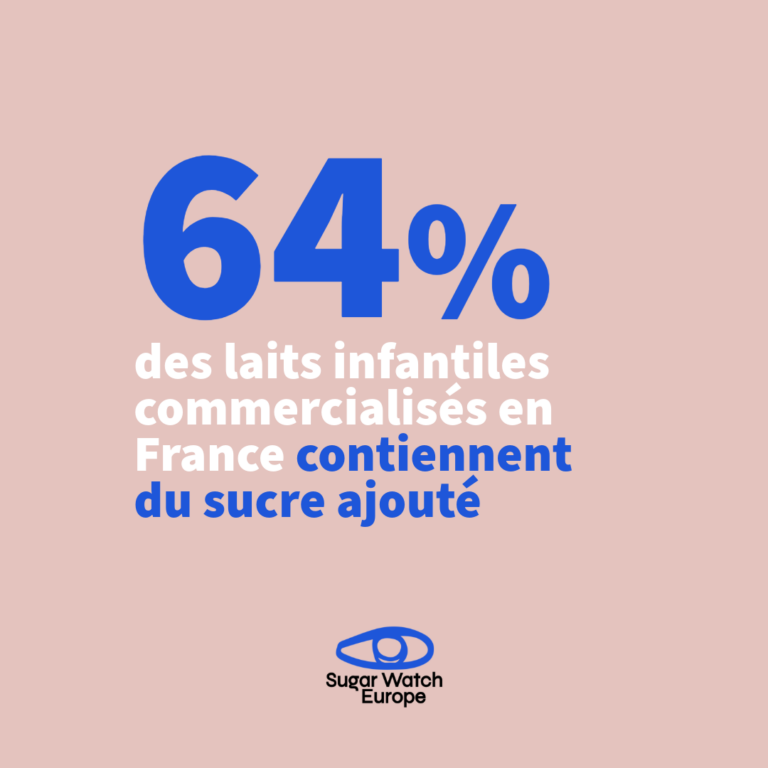
SugarWatch Europe analysed a sample of 59 infant formulas sold in France. We found that most of the products on sale (64%) contained added sugars, and that only a third of the formulas (36%) had none, which shows that it is technically possible to do without them.
This study, set within the European regulatory framework, raises questions about how far industry practices are aligned with public health recommendations to limit free (or added) sugars in young children.
Context and methodology
For infant formula, the European Union has a harmonised regulatory framework for products intended for children, notably Regulation (EU) No 609/2013 and Delegated Regulation (EU) 2016/127.
Against this background, we used France as our field of observation: a market representative of the practices allowed across the whole EU internal market. The aim of this survey was not to cover the entire market, but to document a panel of products large enough to observe industry practices that are authorised, and reproducible, throughout the Union.
We analysed the nutrition labels and ingredient lists published by the manufacturers of 59 first-age infant formulas sold in France in 2025. In the interest of impartiality, SugarWatch Europe draws attention to several limitations of this study:
- As stated in the introduction, our sample, although representative, does not cover the entire French market, but it is large enough to be meaningful and representative;
- This survey may need to be complemented by studies in, and with, other Member States;
- Finally, the long-term effects of added sugars in infant food require more longitudinal research to establish definitive causal links.
Nevertheless, like the study carried out by Public Eye on infant formulas sold on the African continent, we draw the attention of consumers and public authorities to the unnecessary presence of added sugars in products intended for very young children.
Most products contain added sugars
Of all the products studied, only 36% contain no added sugar and rely solely on lactose, the sugar naturally present in breast milk.
Conversely, 64% of our sample contains added sugars in the form of maltodextrin (54%), glucose syrup (5%) or modified starch. Of all the products our NGO scanned, only 36% of baby milks (20 products) contain none of these processed sugars.
In some products, we also observed considerably high levels, reaching up to 7.8 grams per 100 grams of powder. While all the products analysed comply with current EU rules, these observations show that the practices we found are not national exceptions but industry choices allowed across the Union. The question, therefore, is the regulatory framework itself, and the role of public authorities in allowing or limiting sugars in products intended for the youngest children.
This situation also deserves particular attention because infant formula is often the only source of food for babies who are not breastfed, for several months. In infant nutrition, carbohydrates make up a large share of energy intake, and every ingredient counts. With products circulating freely across the EU, where sometimes only the product or brand names change, we call on European and national public authorities to adopt and share sound public health recommendations on this issue at European level.
Industry justifications and possible alternatives
Manufacturers justify adding maltodextrin, glucose syrup or modified starches on technical and/or economic grounds. They cite the need to improve the solubility of the powder in water, to keep the formula stable, or to thicken certain “comfort” or anti-reflux milks.
But the economic dimension plays the biggest role: for manufacturers, maltodextrin costs far less to buy than lactose. In a highly competitive and standardised European market, these formulation choices respond first and foremost to transnational economic logic, well beyond the French market alone.
Our analysis also shows that adding sugars does not meet an absolute technical need, since more than a third of the milks analysed use only lactose while fully complying with the European regulatory framework.
These milks (see the full data in the infographics section) show that it is possible to make quality infant formula without added sugars.
These brands operate in several European countries and show that formulations without added sugars are compatible with the regulatory and commercial requirements of the internal market. The existence of these products is further proof that adding sugars is above all an industry choice rather than an unavoidable technical constraint.
This conclusion is fundamental, because it means that every gram of sugar added to infant formula results from a deliberate decision that could be made differently. And this finding goes beyond the French case, since it questions the industry choices made across the European market.
Public health recommendations and the regulatory gap
International recommendations on infant nutrition nevertheless agree on the need to drastically limit free sugars, that is, added sugars, in young children.
The WHO, first of all, recommends drastically limiting free sugars from the earliest age, and clearly distinguishes lactose, the natural carbohydrate in breast milk, from added sugars, whose intake should be minimised. The European Commission and paediatric societies share this approach, recommending a free sugar intake close to zero for infants, apart from lactose, the only sugar naturally present in breast milk.
Breast milk should be the nutritional benchmark for infant formula, since its only source of carbohydrate is lactose. This should be the starting point for industrial formulas: what scientific justification is there for tolerating added sugars in formulas intended for healthy infants? To date, no study shows that a healthy baby needs added sugars beyond lactose.
Although the EU legal framework governs the composition and labelling of infant food (Regulation (EU) No 609/2013, Delegated Regulation (EU) 2016/127 and Regulation (EU) No 1169/2011), it sets no explicit limit on added sugars, nor any nutritional hierarchy between the different authorised sources of carbohydrate.
In practice, this gap allows manufacturers to use processed sugars such as maltodextrins or glucose syrups in products intended for infants, even though Article 168 TFEU requires a high level of human health protection and Article 24 of the Charter of Fundamental Rights of the European Union makes the best interests of the child a primary consideration.
There is therefore a mismatch between public health recommendations, which call for minimising free sugars, and current rules, which tolerate sometimes high levels of added sugars in infant formula. This gap deserves to be examined from the standpoint of European policy coherence, so that these fundamental protection principles of the Union are given real effect.
Documented health risks and open questions
From a scientific point of view, the current literature identifies several risks associated with early exposure to added sugars, although some long-term effects still require further studies to establish definitive causal links.
The impact on dental health is the most immediate and best documented risk: free sugars increase the risk of early childhood caries, which remains a recognised public health problem among young children in Europe.
The risk of overweight and obesity is a longer-term concern, since added sugars promote weight gain and may disrupt metabolic regulation from the first months of life. In this respect, a European longitudinal study by Jardí and colleagues in 2019 found that a higher intake of free sugars at 12 months is significantly associated with a higher risk of overweight at 30 months. These data suggest that early exposure could affect a child’s weight trajectory.
Although more research is needed to establish definitive causal mechanisms and assess very long-term effects, the precautionary principle, particularly in public health, should apply.
One of the most worrying potential effects concerns taste programming: scientific data suggest that early exposure to sugars may encourage a lasting preference for sweet tastes, persisting throughout life and steering future food choices towards sweeter products. This early “education” of the palate, at an age when infants have no ability to choose, should alert public authorities in terms of education and awareness.
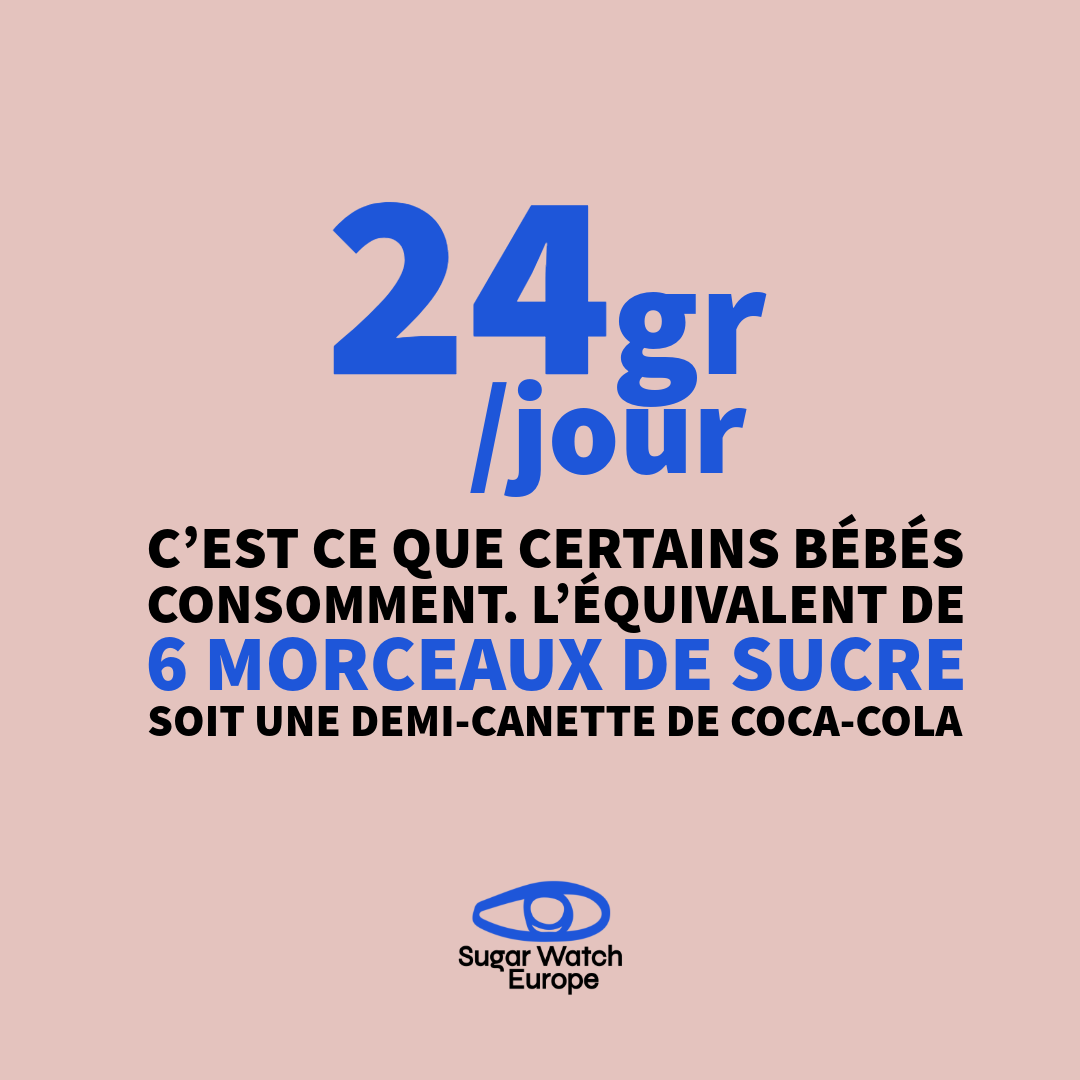
Finally, to illustrate the potential scale of infants’ exposure to free sugars: a baby drinking 800 millilitres a day (about 4 bottles) of a milk containing 3 grams of added sugars per 100 millilitres (the average found in our study) would take in 24 grams of added sugars every day, roughly the equivalent of 6 sugar cubes a day (the equivalent of half a can of Coca-Cola).
Repeated day after day during the first months of life, this exposure raises questions about its long-term consequences for metabolic programming, food preferences and weight trajectory. In the most extreme cases observed in our sample, this difference can amount to up to 60 grams of added sugars a day (a can and a half a day), which justifies a precautionary approach even without a definitive scientific consensus on all the long-term effects.
Price and added sugar content: what the data show
The economic argument that added sugars such as maltodextrin reduce production costs for manufacturers, and therefore potentially prices for consumers, deserves careful scrutiny, because our panel points the other way.
There is a positive correlation between added sugar content and retail price, with a correlation coefficient of around 0.31. Put simply, milks with more added sugars tend to be sold at higher prices than those with little or none.
A comparison of average prices confirms this trend. Milks with 2 grams or less of added sugars per 100 grams of powder cost 19.77 euros on average, while those above this threshold cost 22.21 euros on average, a difference of 2.44 euros. The milks with the highest added sugar content on the French market are therefore, on average, more expensive than their less sugary counterparts.
This finding contradicts the idea that added sugars make products more affordable for families. In reality, the milks richest in added sugars often belong to ranges marketed as “premium”, “AR” (anti-regurgitation) or “comfort”. These products are sold with specific promises such as aiding digestion, reducing colic or thickening the milk. These “premium” segmentation strategies can be seen across the European market and appear to rest more on marketing promises than on scientifically demonstrated nutritional improvements.
This price dynamic raises questions about the consistency between industry discourse and commercial reality. If added sugars do reduce production costs for manufacturers, the savings are clearly not passed on to consumer prices. Families looking for solutions for babies with digestive problems are offered specialised milks that are both more expensive and richer in added sugars, with no demonstrated nutritional benefit compared with standard formulas using only lactose.
Interactive infographic of our study
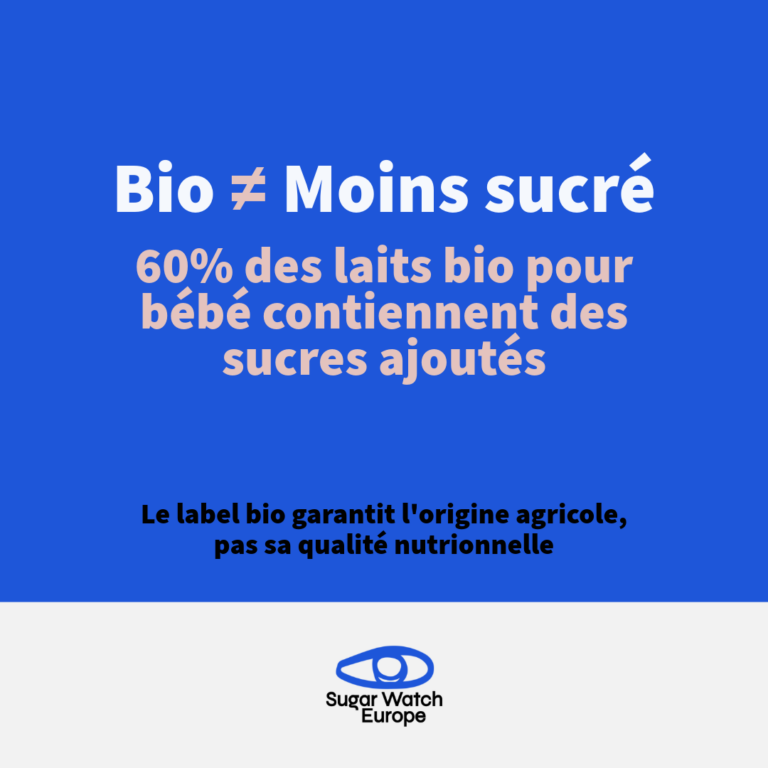
Organic labels do not guarantee the absence of added sugars
Given these market realities, consumers may be tempted to turn to organic products to protect themselves from the risks of free sugars in infant formula.
However, the European regulatory framework for organic farming does not prohibit organic added sugars in infant formula. The organic label certifies the agricultural origin of ingredients and the way they are produced, never their intrinsic nutritional quality or their consistency with public health recommendations on free sugars.
This fundamental distinction between organic certification and nutritional composition is not always obvious to consumers.
Our analysis shows that several certified organic milks contain significant amounts of added sugars. To give just two examples, Babybio Primea 1, certified organic, contains 2.6 grams of added sugars per 100 millilitres. Holle Bio 1, despite its double organic and Demeter certification, contains 1.9 grams of added sugars per 100 millilitres. Although these products meet the requirements of organic farming, they depart from nutritional recommendations to limit free sugars. Conversely, several non-organic milks contain zero grams of added sugar, and no maltodextrin or modified starch, showing that the absence of organic certification is not incompatible with an optimal nutritional composition.
This is a major information issue, since many parents instinctively associate the organic label with better nutritional quality or a lower sugar content.
The frequent association of “organic” with “healthy” in marketing can reinforce this perception. Parents who care about their child’s diet and are willing to spend more on certified organic products may therefore end up choosing milks with more added sugars than cheaper conventional alternatives.
This underlines the importance of clear and accessible nutrition information (Nutri-Score), so that consumers can tell apart what relates to the farming method from what relates to nutritional composition.
Fair access to infant food that meets recommendations
Our survey raises the question of fair access, across Europe, to infant food that meets public health recommendations.
The first issue concerns families whose infants have digestive problems. Babies who need specialised formulas because of reflux, colic or allergies are often offered milks that are both more expensive and richer in added sugars. This exposes the most vulnerable infants, those who need special formulas, to the highest doses of added sugars, without this exposure being justified by demonstrated benefits for their specific condition.
The second issue concerns access to information.
Do parents today have the tools they need to easily identify products without added sugars, given how complex labelling is? Nutrition labelling, as harmonised at EU level, does not clearly distinguish lactose from added sugars in standard nutrition tables. Parents have to decipher ingredient lists in search of technical terms such as “maltodextrin” or “modified starch”, without necessarily understanding what they mean or their nutritional impact. This opacity limits consumers’ ability to make truly informed choices.
The third issue concerns the consistency of “premium” ranges.
Products marketed as the best for infants are not always the most consistent with nutritional recommendations on free sugars. This gap between marketing promises and nutritional reality can mislead parents who, in good faith, think they are making the best choice for their child by opting for products presented as top of the range.
The current situation creates variability in exposure to added sugars depending on several factors:
- parents’ level of nutritional knowledge,
- their ability to decode technical labels,
- their financial resources,
- and the products available where they live.
These differences in access to clear information, and in the ability to make choices that meet public health recommendations, are a question of fairness at European level, all the more so in an internal market where the same products circulate freely between Member States and where public health recommendations can differ from one Member State to another. Since the principles of health protection and the best interests of the child are enshrined in the Union’s founding texts, this inequality in access to nutrition information deserves to be treated as a matter of collective concern.
SugarWatch Europe's recommendations
In light of these findings, SugarWatch Europe makes five recommendations to better protect infants’ health and to make industry practices, regulation and public health recommendations more consistent:
Strictly regulate the use of maltodextrin, glucose syrup and modified starches
These ingredients should be limited to therapeutic formulas where they are strictly necessary, with documented medical justification. Their routine presence in milks intended for healthy infants is not supported by any scientific recommendation and departs from health authorities’ guidance on limiting free sugars.
Make lactose the only default source of carbohydrate in standard infant formula
Breast milk contains only lactose as a source of carbohydrate, and infant formula should follow this benchmark. Our survey shows that this is technically possible: 36% of the products analysed already do so, while meeting European nutritional standards and ensuring good solubility and commercial acceptability.
Make clear dual labelling on packaging mandatory
Labels should clearly distinguish “Lactose (natural milk sugar)” from “Added sugars (excluding lactose)” in the nutrition table. At present, parents cannot tell these two categories apart in standard nutrition labelling, which prevents them from making truly informed choices. This opacity serves neither consumer information nor public health.
Give parents clear and accessible information on added sugars
Parents should no longer be left alone with ingredient lists where maltodextrins, modified starches and glucose syrups hide behind technical names. Clear, accessible and verifiable information on the presence and amount of added sugars is a prerequisite for families to make choices that meet public health recommendations, whatever their level of nutritional expertise.
Align infant formula rules with public health recommendations
Health authorities, whether the WHO, the European Commission or paediatric societies, recommend strictly minimising free sugars in young children. There is a gap between these clear recommendations and rules that tolerate sometimes very high levels of added sugars in infant formula. This gap should be closed, for the sake of coherent European public policy and of prevention from the first months of life.
Conclusions
This analysis of 59 infant formulas sold in France under the European regulatory framework leads to several conclusions.
First, producing infant formula without added sugars is technically possible, as shown by the 36% of products analysed that use only lactose while meeting all regulatory and commercial requirements.
Second, the organic label is no guarantee that a product is free of added sugars. This can create confusion that harms parents’ choices, since they instinctively associate organic certification with optimal nutritional quality, and it can amount to marketing manipulation.
Third, the products richest in added sugars are on average more expensive than their less sugary counterparts, which makes the sweetest products more profitable for manufacturers, given the lower cost of the lactose substitutes used in the formulas.
Finally, there is a significant gap between public health recommendations, which call for minimising free sugars from the earliest age, and the industry practices allowed by the current regulatory framework.
Current scientific knowledge, although some long-term effects need further study, points towards a precautionary approach to early exposure to free sugars. Current labelling, harmonised at EU level, does not allow parents to easily identify the presence and amount of added sugars in infant formula, which limits their ability to make informed choices in line with public health recommendations.
The infant formula market today shows great diversity in formulation choices. Some manufacturers choose to follow the model of breast milk by using only lactose as a source of carbohydrate, demonstrating the technical and commercial feasibility of this approach. Others add processed sugars, mainly for technical and economic reasons, without any scientifically demonstrated benefit for infants’ health.
This diversity of practices, all allowed by the European regulatory framework, raises the question of how consistently the health protection objectives enshrined in the Union’s founding texts are translated into the standards that apply to the infant food industry.
Infants and their parents deserve greater transparency in nutrition information. Manufacturers have a responsibility to put infants’ health first in their formulation decisions, particularly when alternatives without added sugars are technically and commercially viable. Public authorities therefore have a duty to ensure a regulatory framework consistent with public health recommendations, and to make sure that all children, without distinction and whatever their parents’ situation, have access to infant formula that meets these recommendations. Our survey shows that quality infant formula can be produced without added sugars. This practice, still a minority at 36% of products, has proven its technical, regulatory and commercial viability. This approach, more consistent with public health recommendations and with the nutritional model of breast milk, should gradually become the norm across the European market. The health of millions of children justifies this change.
Contact:
References
Scientific source cited:
Jardí, C., et al. (2019). Association between free sugar intake and cardiometabolic risk factors in European children: the IDEFICS study. International Journal of Obesity.
European regulatory framework:
Regulation (EU) No 609/2013 on food intended for infants and young children; Commission Delegated Regulation (EU) 2016/127 supplementing Regulation (EU) No 609/2013 as regards the specific compositional and information requirements for infant formula and follow-on formula; Regulation (EU) No 1169/2011 on the provision of food information to consumers.
Founding texts of the European Union:
Article 168 of the Treaty on the Functioning of the European Union (TFEU); Article 24 of the Charter of Fundamental Rights of the European Union.
International recommendations:
World Health Organization, Guideline on sugars intake for adults and children; European Commission, guidance on infant nutrition.